Ultra-Processed Does NOT Automatically Mean Unhealthy
And before you come for me… hear me out.
First though, a big thank you to the Center for Food Integrity and the Growing a Healthier America initiative for sponsoring this blog post, because this is a topic we need to further dissect.
“Ultra-processed food” has become one of the biggest buzzwords in nutrition right now, consistently. It’s in headlines, on social media, in wellness podcasts, and all over your grocery store. And it is almost always discussed with lots of FEAR around it.
And because of that, it is ok to feel curious and have questions about it all! But I want to push heavy on the curiosity and fact finding angle.
Because, as your facts over fear dietitian I want to quickly remind you that fear is never a successful educational tool.
So first, it’s important to understand what the term ultra-processed food actually means.
UPF is a classification system. It is not a nutrition grading system.
That distinction matters.
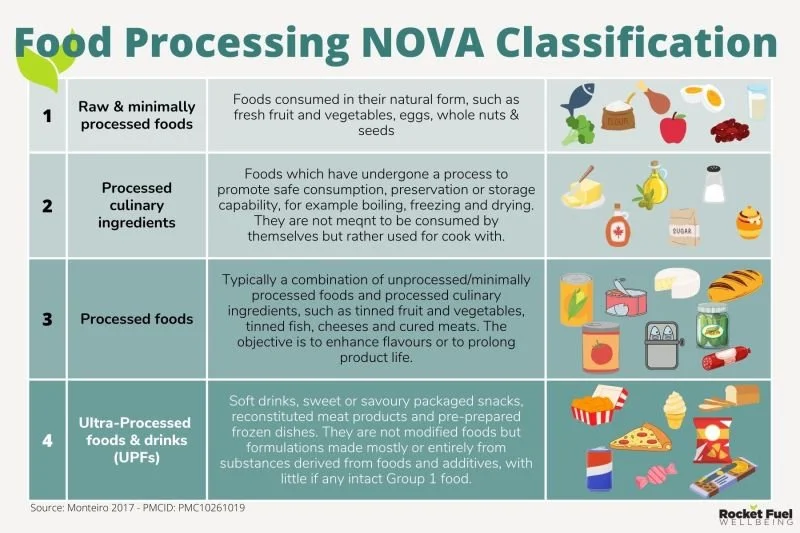
The NOVA system categorizes foods based on the degree and purpose of processing, not simply whether a food is “healthy” or “unhealthy,” or “good” or “bad.”
And this is where things start to get messy. For a lot of reasons, but as a dietitian who has worked with eating disorders as well, it is also so important to call out that healthy truly means something different to EVERYONE.
When you see the words ultra-processed, it’s very easy to mentally translate that into bad for you.
But those are not interchangeable terms.
In fact, I always think it’s interesting to look at some of the products that we routinely think of as being synonymous with “health.”

Some supplements can fall into the ultra-processed category, depending on the product and how it is formulated. Specifically protein isolate is called out on the website - I mean what do we think some of the wellness influencers would say about that?!
BUT pause, I’m not saying that to tell you supplements are bad. You know I use and enjoy them too!
But, I’m saying it because the label “ultra-processed” alone doesn't tell you everything you need to know about a food or product.
So what does the research actually tell us?
A recent study covered by Good Morning America looked at more than 50 studies involving nearly 9 million adults and found that higher intake of ultra-processed foods was associated with higher risks of several health conditions.
And that sounds scary.
But here’s the part that can get completely lost in the headline: association does not equal causation.
This is one of the most important concepts in nutrition science. And again, calling out a pause here that nutrition IS A SCIENCE and not just an opinion.
When researchers find that two things occur together, that doesn't automatically mean one caused the other.
For example, people who consume more ultra-processed foods may also differ in a number of other ways that can affect health, things like medical history, family history, social health, overall dietary patterns, physical activity, sleep, socioeconomic factors, smoking, access to health care, stress and food access to name a few.
That doesn't mean the research should be ignored.
It means we need to interpret it appropriately. And not use rage bait headlines to scare people.
Being able to say YES AND, is really important. Because YES a diet full of UPFs and nothing more or mostly UPFs has room for improvement AND a diet that contains UPFs WITH foods from the other categories can be a goal to strive for that someone can consistently stick to.
We can acknowledge that diets very high in ultra-processed foods may be associated with poorer health outcomes without turning every individual UPF into a nutritional villain.
Those are two very different statements.
context matters.
If someone's entire diet is made up of ultra-processed foods, that's a very different situation than someone who occasionally eats a packaged snack, uses a convenience meal on a busy night, or has a protein bar in their bag because they haven't had time to eat.
OR the mom that gives fresh fruit and veggies at dinner alongside dino nuggets.
Arguably that meal is incredibly healthy for that child eating it even if it is every night.
AND being devil’s advocate that mom (hi me) can also be working towards adding in fresh cooked chicken too.
The food doesn't exist in isolation.
The dietary pattern matters.
And this is where I think we can have a much more productive conversation.
Instead of asking:
“Is this food ultra-processed?”
I want you to start asking:
What does my overall diet look like?
Am I getting enough fruits and vegetables?
Am I eating enough protein?
Am I getting sources of fiber?
Am I eating whole grains and other nutrient-dense carbohydrates?
Am I getting enough healthy fats?
Am I eating enough food, period?
How does the food I am eating make me feel?
Am I pairing food groups together?
Is what I am eating keeping me full?
Am I eating a nice variety of food?!
How do I feel while eating? After eating? Before eating?
What is my environment like while eating?
And perhaps most importantly:
Does the way I'm eating actually work for my life? AND MAKE ME FEEL GOOD!
These things matter so much.
You can think of nutrition as more of a puzzle and a game than a straight math formula. Finding the combos and the brands and the things work best for you is not going to be the same as what works for someone else, and that is part of the game.
And life, happens. And sometimes life makes some days harder to make food the way you wanted it but when you understand nutrition and understand how to meet your needs you also understand that convenience is not a moral failure. And this matters.
Sometimes packaged food is what makes it possible for someone to eat.
Sometimes a frozen meal is dinner.
Sometimes a protein bar is breakfast paired with a piece of fruit.
Sometimes the snack in your purse is the difference between eating something and going hours without food, and this dietitian would be thrilled you ate something.
And we cannot talk about nutrition without talking about access.
Not everyone has the same budget, time, kitchen, transportation, food availability, cooking skills or energy.
Telling people to simply “avoid ultra-processed foods” without addressing those realities is not particularly helpful nutrition advice.
And this is where I think we need to be careful with fear-based messaging.
We've spent decades telling people that fat is bad.
Then carbs became the enemy.
Then sugar.
Then big bad seed oils.
Now we're putting “ultra-processed” on the list and screaming about it.
And every time we create a new category of foods to fear, people become more confused about what they're actually supposed to eat.
Nutrition is not supposed to be a scavenger hunt for the least processed food in the grocery store.
It's about patterns.
It's about adequacy.
It's about variety.
It's about nutrients.
It's about enjoyment.
It's about culture.
It's about convenience.
And yes, it's about health.
So what should you actually do?
Look at your overall dietary pattern.
If you're able to, add more fruits and vegetables.
Include sources of protein and fiber.
Choose nutrient-dense foods regularly.
Pair your food groups together, I always recommend 2-3 at a time.
Eat enough, consistently. Find what works for your schedule!
And when it makes sense for you, choose less-processed foods not because processed foods are inherently bad, but because variety gives your diet more opportunities to provide the nutrients your body needs.
And after eating, always take note of how you feel, when you feel good - repeat what worked, when you don’t, ask questions and find out what you can tweak to feel better next time.
We got this!
Food should be fun, not feared.
XO,
Jenna